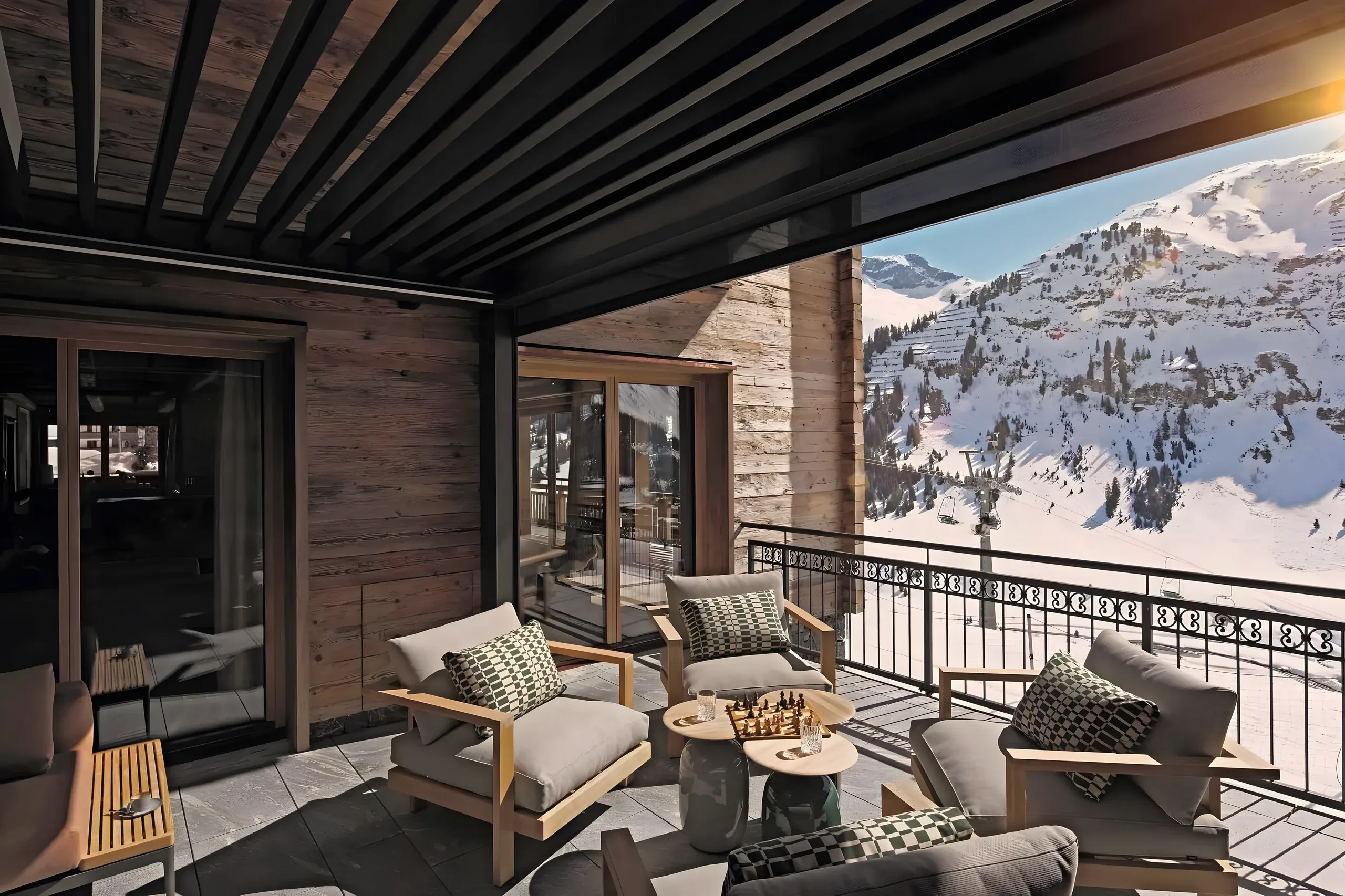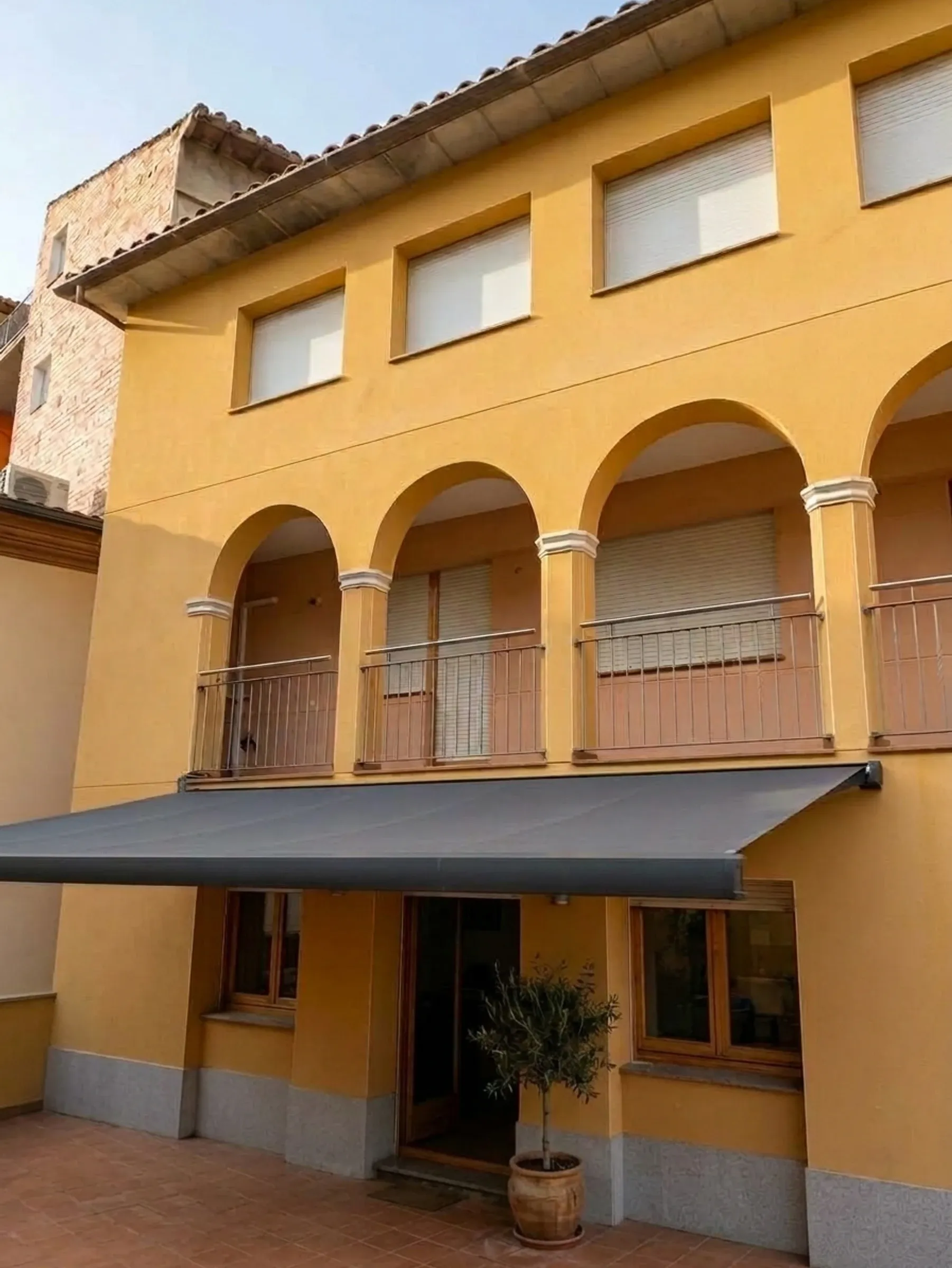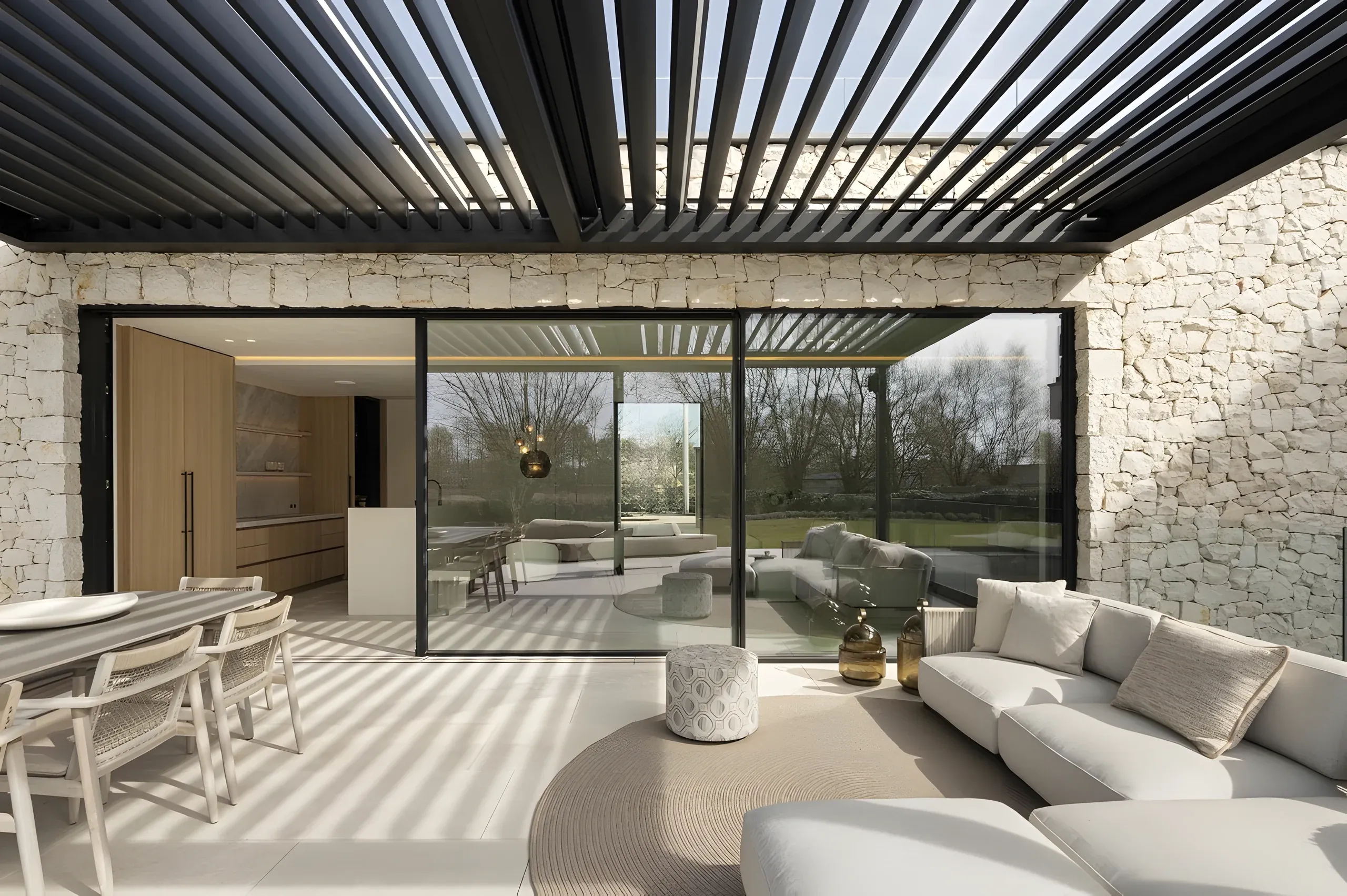
Gaining usable space in your garden or on your terrace, without giving it up whenever the sun beats down, an August afternoon downpour rolls in or the tramontana (the cold northerly wind) starts to blow, is one of the investments that make the biggest difference to everyday life in a Catalan home. A bioclimatic pergola solves that problem, but not all pergolas are equal and not every house calls for the same set-up. This guide walks you, step by step, through what to look at before choosing a bioclimatic pergola: from how you will actually use it to the louvres, motorisation, finishes and aftercare service.
What exactly is a bioclimatic pergola?
A bioclimatic pergola is an aluminium structure with a roof of adjustable louvres that rotate on their own axis. Unlike a traditional pergola with a fabric or polycarbonate cover, a bioclimatic pergola features louvres that can be tilted to any angle between fully closed and fully open. That lets you control how much light comes in, regulate ventilation and, with the louvres completely shut, stay dry in the rain thanks to the drainage system built into the posts.
In practice it is a smart roof: in summer you open the louvres in the middle of the day to let cool air flow through and close them in the late afternoon to block the low western sun; in autumn and winter you make the most of sunny days by keeping them open and close them as soon as a front comes in. Properly sized and properly installed, it turns a seasonal terrace into another room of the house, usable for much of the year.
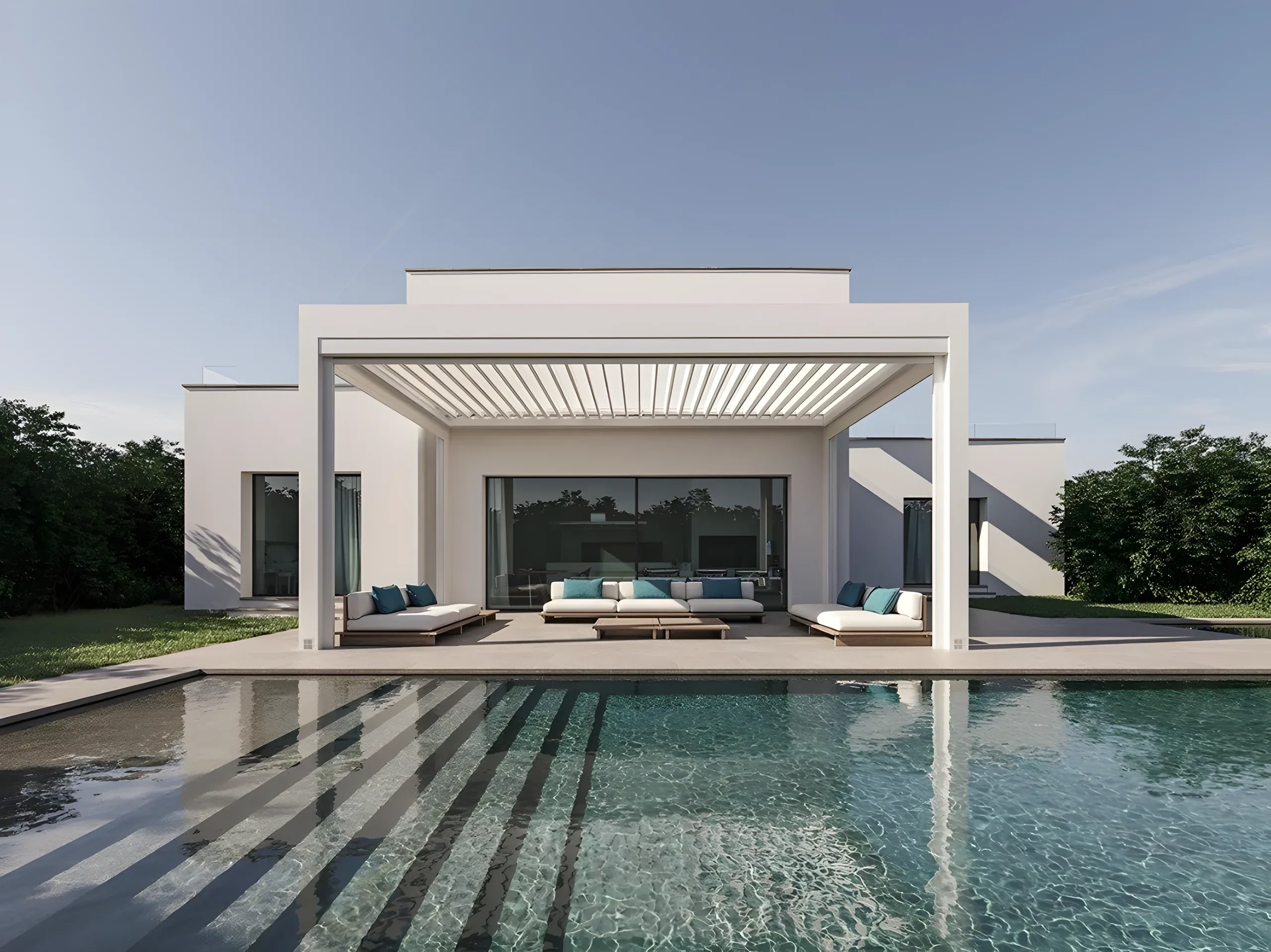
1. Define how you will use it and where it will go
Before browsing catalogues, it pays to stop and calmly answer three questions: where it will go, what you will use it for and how many months a year you want to enjoy it. Covering the outdoor sofa corner of a penthouse in Manresa is not the same as enclosing a restaurant terrace in Vic or creating a dining area by the pool of a house in the Berguedà.
- Wall-mounted terrace pergola: we usually anchor the pergola to the wall on one side, which means fewer posts and a more open space.
- Freestanding structure (garden or detached porch): a self-supporting structure on four or more posts, anchored to a concrete base.
- Penthouse with a raised floor: the anchoring has to be planned so the waterproofing is not pierced.
- Hospitality: linked modules, side enclosures and dual motorisation by zone.
Deciding whether you only need occasional shade or protection from rain and wind as well is what separates sticking with an awning from taking the step to a made-to-measure bioclimatic pergola. During our free, no-obligation consultation visit we help you put it all down on paper.
2. Materials: why aluminium
The standard material for a bioclimatic pergola is extruded aluminium, usually oven-baked with a polyester powder coating in the RAL colour of your choice. This is not an aesthetic whim: aluminium combines three properties that timber or steel cannot offer all at once in an outdoor roof exposed to sun, rain and snow.
- Corrosion resistance: aluminium does not rust, which is crucial in damp, frost-prone areas such as the Berguedà or the Cerdanya.
- Light yet rigid: it can span large distances with slim profiles, with no need for intermediate posts.
- Minimal maintenance: a yearly wash with mild soap and water is enough to keep the coating in good condition.
An architectural-grade coating (Qualicoat certification or equivalent) is what ensures the colour does not fade after just a few summers. Always ask about the type of paint, the thickness of the profile and the warranty on the finish: these are the details that separate a durable aluminium pergola from one that ages badly.
3. Adjustable louvres: the heart of the system
The adjustable louvres are what make the pergola bioclimatic. They rotate in sync via an internal bar driven by a motor and can stop at any position between 0° and roughly 140°, depending on the model. That freedom of angle is what lets you play with the light throughout the day.
- Louvre profile: wing-shaped louvres with an aerodynamic cross-section drain better and offer less wind resistance.
- Drainage system: with the louvres closed, water runs into gutters in the crossbeams and down inside the posts to the drain.
- Seals between louvres: EPDM seals prevent drips between louvres during heavy rain.
- Rain sensor: closes the louvres automatically at the first sign of rain, even when you are not at home.
One detail worth checking: the slope of the louvres when closed. A minimum gradient of 5–7% ensures water flows properly into the collection gutter instead of pooling.
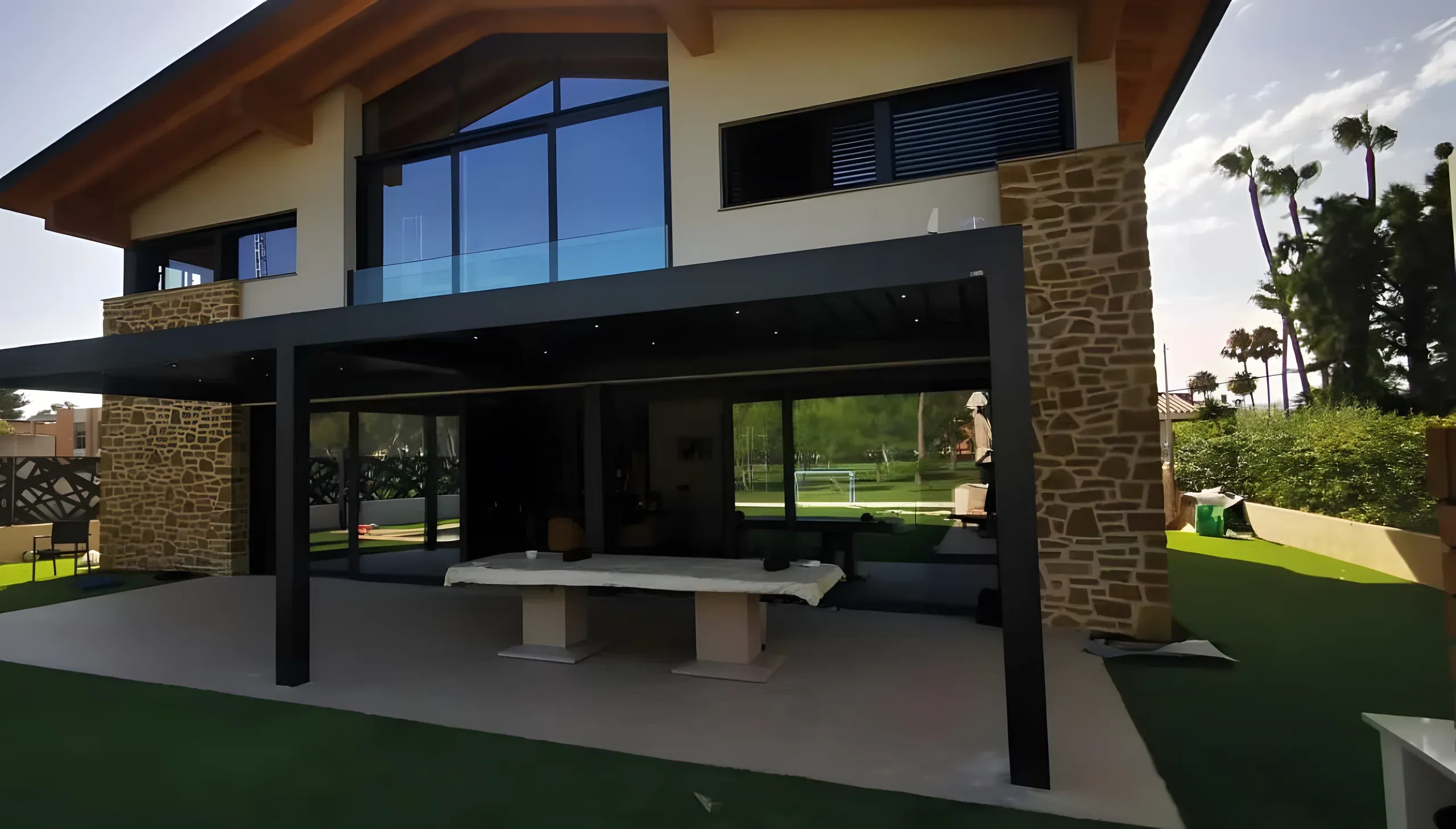
4. Motorisation and home automation
Almost every bioclimatic pergola today is motorised. A quiet tubular motor built into a crossbeam moves the louvres via a radio remote control, with no visible wiring. From there, the automation options are what determine real day-to-day convenience.
- Rain sensor: closes the louvres as soon as it starts to rain.
- Wind sensor: moves them to a safe position when gusts exceed a set threshold.
- Sun sensor: adjusts the angle according to solar radiation.
- Home automation integration: compatible with systems such as Somfy TaHoma, KNX or voice assistants.
They may look like optional extras, but rain and wind sensors are what really spare you any nasty surprises when you are away. It is worth planning for them from the start, even if you leave activating them for a second phase.
5. Colour, finishes and lighting
The finish is where the pergola stops being a catalogue product and becomes part of the house. The RAL colour of the aluminium should be chosen to suit the façade, the window frames and the terrace paving, not the trend of the year.
- Anthracite and stone-grey tones: pair well with natural stone and the rustic façades of the Berguedà.
- Off-whites and cream: make small terraces and city penthouses feel lighter.
- Matt black: the current trend in contemporary architecture.
As for lighting, LED strips built into the perimeter crossbeams have become standard and can be dimmed from the same remote that controls the louvres. Other interesting options include side enclosures with glass curtains or motorised screens, infrared ceiling heaters and built-in speakers for hospitality spaces.
6. Local climate: the Berguedà, the Cerdanya and snow
A pergola that works perfectly on the coast may fall short at 1,200 metres in Bagà or Puigcerdà. Altitude, exposure to northerly winds and, above all, snow load are decisive factors when sizing the structure.
- Snow load: at high altitude it is advisable to use reinforced profiles and reduce the spacing between posts.
- Wind: the Pyrenean valleys see gusts that call for chemical anchors and well-calibrated wind sensors.
- Frost: EPDM seals and sealants must be suitable for freeze–thaw cycles.
- South–south-west orientation: the most demanding in summer; it is worth combining the louvres with a side screen.
That is why a made-to-measure pergola is not just a matter of centimetres: it also means choosing the profile section, louvre thickness and type of fixing that suit the exact spot where it will be installed.
7. Installation, permits and aftercare
Installing a pergola in Berga (or Manresa, Vic or Puigcerdà) starts with a technical visit in which we take measurements, check the possible anchor points and review access. From there we prepare a detailed proposal with drawings, colour, accessories and lead time. Once approved, the pergola is manufactured in the workshop and usually assembled on site in one or two days.
- Permits: most municipalities require at least a prior notification; we will advise you during the visit.
- Warranty: the structure and motor usually carry a manufacturer’s warranty of several years, separate from the finish.
- Local aftercare service: servicing, spare parts and sensor reprogramming by our own technicians.
Having someone to call in the high season when a sensor fails or a louvre needs adjusting is worth more than any brochure. That is why we only work in the areas we can serve well: the Berguedà, Bages, Osona and the Cerdanya.
Find out more about our bioclimatic pergolas and our installation area in Berga and the Berguedà.
For more on wind and snow load standards for outdoor structures in mountain areas, see the climate information from AEMET, Spain’s national weather agency.
Frequently asked questions
What is the difference between a bioclimatic pergola and an awning?
An awning is a retractable fabric canopy that provides shade and rolls away when you don't need it; it protects you from the sun, but it can't be used in heavy rain or strong wind. A bioclimatic pergola is a fixed aluminium structure with a roof of adjustable louvres that rotate on their axis, letting you control ventilation and light and, with the louvres closed, keep the rain out too. It's designed so you can use your terrace practically all year round.
What standard sizes do bioclimatic pergolas usually come in?
Bioclimatic pergolas are made to measure, so the dimensions adapt to the space available. As a guide, typical single modules are around 3 × 3, 3 × 4, 4 × 5 or 4 × 6 metres, and modules can be joined to cover larger areas in detached houses, penthouses or restaurant terraces. Typical clear height is between 2.3 and 2.8 metres, always checked during the site visit to allow for slopes and local regulations.
Do I need planning permission to install a pergola?
It depends on the municipality and on whether the pergola counts as minor works or as a structure attached to the façade. Most town councils in the Berguedà, Bages, Osona and the Cerdanya require at least a prior notification or a minor works licence, especially if it is anchored to a floor slab or a party wall. During our free, no-obligation consultation visit we'll point you to the usual paperwork, although the application itself is the responsibility of the owner or their architect.
How long does it take to install a bioclimatic pergola?
On-site assembly of a standard pergola usually takes one or two days, provided the anchoring is ready and there is access to unload the aluminium. The overall lead time from accepting the quote includes made-to-measure manufacturing in our workshop, which normally takes several weeks depending on the RAL colour, finishes and accessories chosen. We confirm the exact date before placing the order.
Can bioclimatic pergolas withstand the snow in the Cerdanya?
Yes, as long as you choose a model sized for the real snow load of the area. At higher altitudes in the Cerdanya and parts of the Berguedà it's best to opt for reinforced profiles, thicker louvres and shorter spans between posts. During the site visit we assess orientation, wind exposure and expected snow build-up to recommend the right configuration, and we put the permissible loads in writing.