When someone asks us for an awning quote, they usually focus on the frame, the motor and the colour. That makes sense, but there is one detail that determines most of the end result: the fabric. A good technical fabric determines how much heat is blocked, what temperature you feel underneath, how many years it keeps its colour and what the façade will look like ten summers from now. In this guide we look at the main families of technical fabrics for awnings, how their solar control performance is measured and what to check before signing a quote, whether for a home or a business in the Berguedà, Bages, Osona or the Cerdanya.
The fabric is half the awning
A well-built aluminium frame can last twenty or thirty years with hardly any maintenance. The fabric, on the other hand, lives outdoors: it takes direct UV radiation, gusts of wind, night-time damp, dust, leaves and, in areas like ours, freeze–thaw cycles. That is why the choice of fabric affects both comfort and long-term cost of ownership so much. A Storbox 400 cassette awning fitted with a quality solution-dyed acrylic ages very differently from the same cassette with a generic lightweight canvas. You can see the difference in the colour after five years, in how it stands up to a gust of wind and in how easy it is to clean. So when we carry out our free, no-obligation consultation at the client’s home, we spend a good part of the visit showing real sample books: seeing the fabric against the light, touching it and comparing colours helps far more than a digital catalogue.

1. Families of technical fabrics
Not all awning fabrics are the same. In residential and commercial installations we usually work with three main families, each with its own logic:
- Solution-dyed acrylic (Sauleda, Dickson Orchestra, Sunbrella): fibres dyed in the mass before spinning, which gives them excellent colourfastness to UV rays. They are opaque, pleasant to the touch, dimensionally stable and come in a wide range of plain colours and stripes. This is the most common choice for classic folding-arm awnings and for cassette awnings.
- Micro-perforated and screen fabrics (Soltis, Serge Ferrari): high-tenacity polyester yarns coated in PVC, woven with a controlled openness factor. They filter heat and protect from the sun without darkening the space, while keeping the view outside. They are the logical choice for vertical awnings, shopfront canopies, restaurant terraces and offices that want to keep their natural light.
- Opaque PVC-coated polyester: heavier fabrics used mainly for vertical awnings, terrace windbreaks and applications that call for near-total opacity and high mechanical strength.
Each family has its place. A residential cassette awning almost always calls for acrylic; a glazed terrace with a view calls for a light screen; a commercial canopy that gets vertical sun for hours can combine a dark screen on the outside with a light acrylic lining inside.
2. How solar protection is measured
When we talk about the solar protection of an awning, we don’t mean a single number but a set of properties. Comprehensive technical data sheets – and the European standard EN 13561 for external awnings – include several indicators:
- Openness factor: the percentage of open area in the fabric. The lower it is, the more shade and the less outward visibility.
- Solar transmittance (Ts): how much solar energy passes straight through the fabric.
- Solar reflectance (Rs): how much is reflected back outside, key to reducing the heat that reaches the glass.
- UV protection factor and light transmittance: how much ultraviolet radiation is blocked and how much visible light gets through.
As a general rule, screen fabrics block between 70 and 95% of solar radiation depending on openness factor and colour. Opaque acrylics, which let no direct light through, block virtually all radiation but build up more heat in the fabric itself, so it is best to combine them with good ventilation.
3. Colour, opacity and perceived temperature
The colour of the fabric affects how warm it feels more than you might think. A light acrylic reflects more radiation and keeps the fabric cooler to the touch, but lets a little more diffused light through, which makes it brighter underneath. A dark acrylic absorbs more heat on its upper side, though in return it reduces glare and gives a more defined shade. Something similar happens with screens: light colours maximise the light indoors and reflect more energy but reduce the view outside; dark ones preserve the view through the fabric better and look more understated, at the cost of absorbing more radiation. For terraces overlooking the Berguedà landscape, for example, we usually recommend screens in graphite or dark grey. Where the priority is gaining diffused light under a porch, acrylics in sand or ecru tones come out on top.

4. Strength and durability
Beyond solar control, a technical awning fabric has to withstand years outdoors. Several parameters come into play here, and they are worth checking on the data sheet:
- Colourfastness to light, assessed under the ISO 105 series of standards. Branded solution-dyed acrylics usually achieve the highest ratings.
- Weight (g/m²): an indication of density and, to some extent, of robustness against wind loads.
- Surface treatments: water-repellent, stain-resistant and self-cleaning finishes that make maintenance easier.
- Tear and abrasion resistance: important in windy areas or when the awning is retracted and extended several times a day.
Manufacturers’ commercial warranties for mid- to high-end fabrics usually range from five to ten years. Under normal use, the weather-resistant technical fabrics we install keep their appearance for considerably longer, especially if a few basic guidelines are followed.
5. Fabrics for cassette and vertical awnings
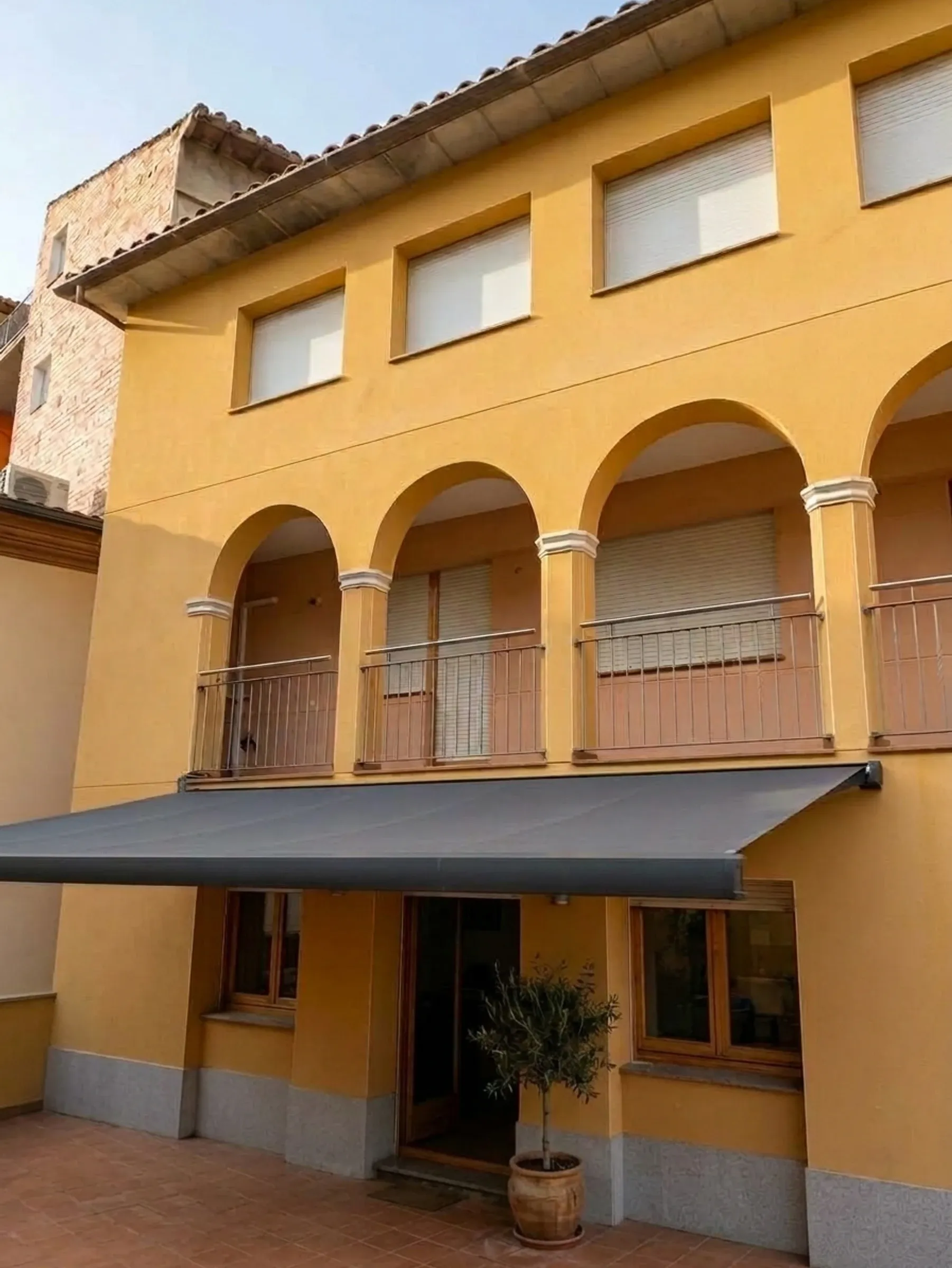
The type of awning determines the fabric. In cassette awnings such as the Storbox 400, the Storbox S 300 or the Splenbox 400, the fabric retracts into a closed aluminium housing when not in use. This protects it from sun and rain while it is rolled up and greatly extends its lifespan. For these models we almost always use solution-dyed acrylics: they offer opacity, drape well, come in a wide palette and work well with folding arms. For vertical awnings – typical on raised terraces, apartment balconies or bar canopies – the picture changes: the fabric is tensioned in side guides and takes sun and wind head-on. Here screen fabric performs very well because it keeps heat out while preserving the view, and opaque coated polyesters are useful when you want a windbreak and privacy. Everything is made to measure: we measure the opening, check the anchor points and choose the best fabric-and-system combination for each façade.
6. Maintenance and lifespan
Maintaining a technical fabric is simple, but a few guidelines are worth following. Ideally, clean the fabric once or twice a year with lukewarm water, neutral soap and a soft brush; never use a pressure washer, which opens up the weave and damages the coatings. If a heavy storm hits, retract the awning: most of the damage we see on aftercare call-outs is not wear and tear but wind or hail on an extended awning. Motorised awnings with a wind sensor make this much easier to manage. With this basic care, a well-chosen technical fabric will last for the entire lifespan of the awning without any surprises.
More about our solar control awnings service and our awning installations in Berga.
For more technical detail on the European standard for external awnings, see EN 13561 via UNE, the Spanish standards body.
Frequently asked questions
What is the difference between an acrylic fabric and a screen fabric?
Solution-dyed acrylic fabric (Sauleda, Dickson Orchestra, Sunbrella) is a dense, opaque cloth, ideal for classic folding-arm or cassette awnings because it gives full shade and a textile feel. Screen fabric (Serge Ferrari, and also Soltis in its micro-perforated range) is an open-weave technical fabric: it filters the sun and blocks much of the radiation, but lets light through and keeps the view outside. That's why screen fabric is more associated with vertical awnings and with shopfronts or offices.
Which fabric suits a south-facing awning in Catalonia?
A south-facing position gets strong sun for many hours, especially in summer. For that exposure, a heavyweight solution-dyed acrylic in a medium or dark colour is a good choice, as it stands up well to UV radiation without fading, or else a screen fabric with a low openness factor (around 3–5 %) if you want to keep the view. In parts of the Berguedà, Bages or Osona, where strong sun and summer storms go together, we also consider the wind resistance of the fabric and the whole awning.
How long does a technical fabric last before it loses its colour?
A solution-dyed acrylic fabric from a reputable brand keeps its colour steadily for ten to fifteen years of normal outdoor use, because the fibre is dyed right through before it is spun. Coated polyester screen fabrics usually offer a similar lifespan in terms of structure, although their finish may age sooner in very salty or polluted environments. Commercial warranties are typically around five years, but the real lifespan is usually much longer.
Can I replace just the fabric without replacing the whole awning?
Yes. If the awning's structure (arms, cassette, brackets, motor) is in good condition, replacing just the canvas is a common job and much cheaper than changing the whole unit. We assess each case individually: we measure, check the condition of the arms and the head rail, and suggest a fabric compatible with the model. It's very common with cassette awnings such as the Storbox 400 or Splenbox 400 that have been installed for ten years and only need new canvas.
Are technical fabrics waterproof or water-resistant?
Most acrylic awning fabrics are water-repellent: they shed the water from light rain, but they aren't waterproof and shouldn't be used as a watertight roof. That's why an awning is no substitute for a bioclimatic pergola with adjustable louvres. Screen fabrics, being open-weave, let water straight through. If you need a genuinely watertight cover against sustained rain, the right solution is a pergola with a louvred roof or a fixed roof, not a fabric awning.